

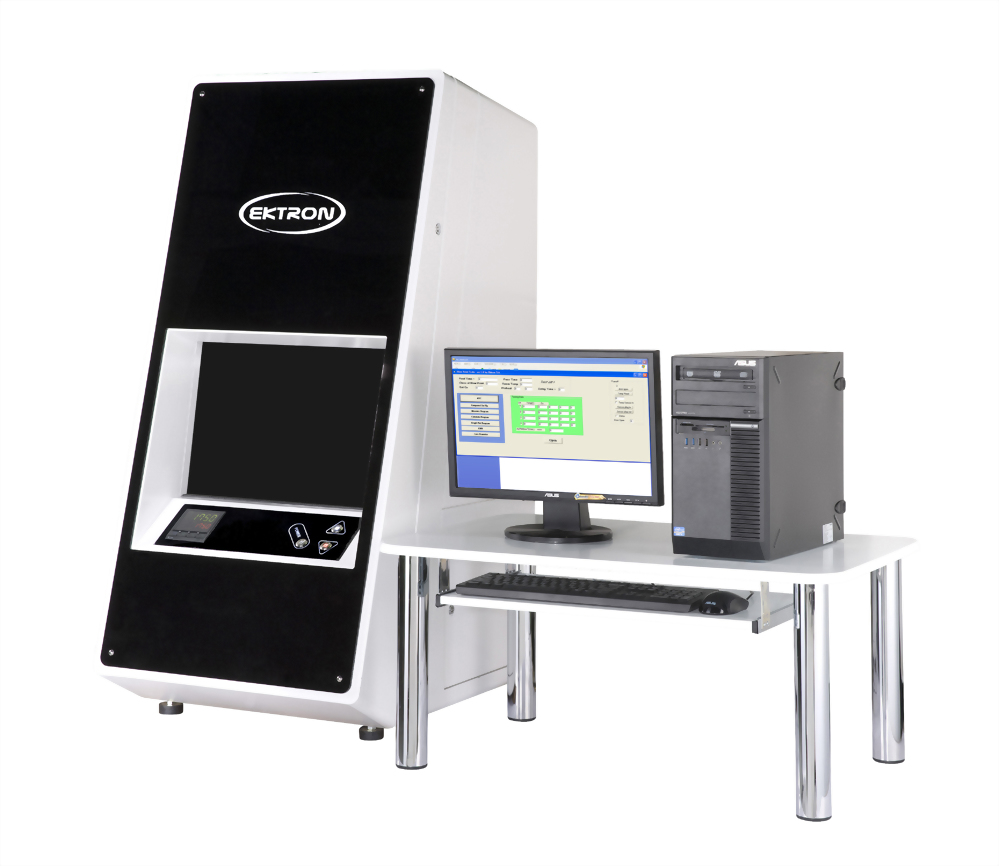
Blow Point Tester
Model :
EKT-2001BPT
The EKT-2001BPT Blow-Point Analyzer is an advanced testing instrument designed for the tire and rubber vibration isolation industries. Utilizing a specialized wedge-typed mold and ultra-precise Pt100 Platinum Resistance Sensors, it analyzes real-time temperature rise across variable thicknesses. It calculates the Heat Diffusion Constant and Equivalent Curing Time, effectively eliminating internal porosity and optimizing factory productivity.
Advanced Wedge-Mold Technology
Specialized Wedge-Typed Mold
Unlike standard flat cavities, the EKT-2001BPT employs a uniquely designed Wedge-Typed Mold. This ingenious shape allows engineers to analyze curing process behaviors across different thicknesses simultaneously. Real-time temperature rising is monitored by four ultra-precise Pt100 Platinum Resistance Sensors (accurate to +/-0.3°C), ensuring perfect thermal mapping.
Precision Data & CCD Imaging
The integrated software processes the thermal data to output highly actionable factory metrics, including the Heat Diffusion Constant, Equivalent Curing Time, and exact Blow Point.
- Helps improve polymer resistance and durability.
- Includes a dedicated cutting device for easy wedge sample prep.
- Optional CCD Image Processing: Visually identifies and records the exact bubble limiting point.
Technical Specifications (EKT-2001BPT)
| Mold Shape | Wedge-Type (Variable Thickness) |
|---|---|
| Heating Method | Special Designed Structure for Uniform Temperature Distribution |
| Test Temperature Range | Room Temp. + 10°C ~ 180°C |
| Testing Points | Four (4) distinct measuring points |
| Temperature Sensor | Pt100 Platinum Resistance Sensor |
| Temperature Accuracy | +/- 0.3°C |
| Power Supply | 1 Phase, 220+/-10V, 50/60Hz |